Academics
Browse All Notes
Union Executive (ICSE Class 10 Civics – Updated Notes)
P
Aven
April 17, 2026 • Study Resource
Meaning of Union Executive
The Union Executive refers to the branch of government that implements and enforces laws in India.
It consists of:
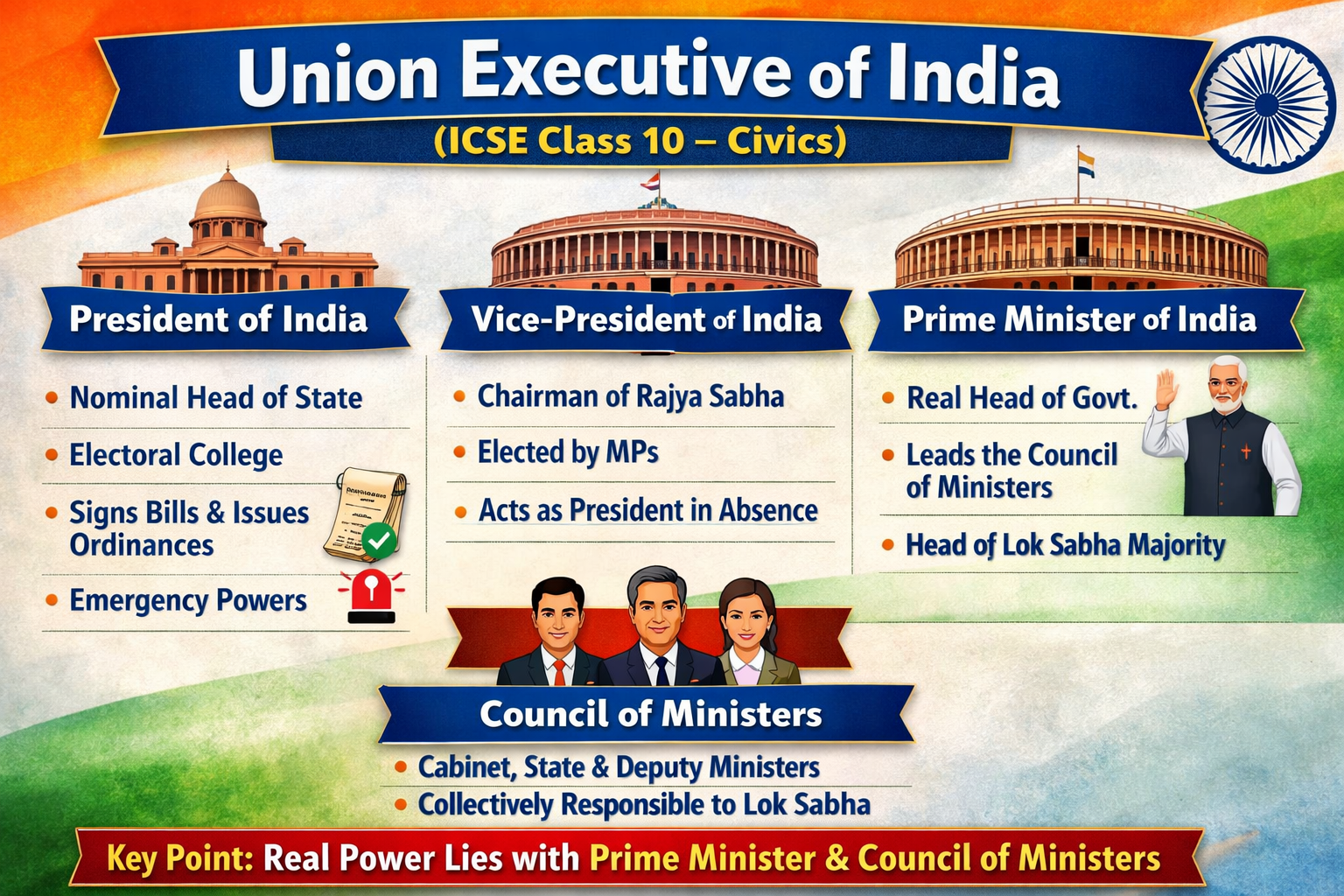
- The President of India
- The Vice-President of India
- The Prime Minister of India
- The Council of Ministers
1. President of India
Position
- Nominal Executive Head
- First citizen of India
- Acts on the advice of the Council of Ministers
Election
- Elected indirectly by an Electoral College:
- Elected MPs (both Houses)
- Elected MLAs of States & Delhi, Puducherry
Term
- 5 years
- Eligible for re-election
Powers of the President
1. Executive Powers
- Appoints Prime Minister and Council of Ministers
- Appoints Governors, Judges, CAG, etc.
2. Legislative Powers
- Summons and prorogues Parliament
- Addresses Parliament
- Gives assent to bills
- Can issue Ordinances when Parliament is not in session
3. Financial Powers
- No Money Bill can be introduced without prior approval
- Causes Union Budget to be presented
4. Judicial Powers
- Can grant Pardon, Reprieve, Respite, Remission, Commutation
5. Emergency Powers
- National Emergency
- State Emergency (President’s Rule)
- Financial Emergency
2. Vice-President of India
Position
- Second highest constitutional authority
Election
- Elected by members of both Houses of Parliament
Functions
- Ex-officio Chairman of the Rajya Sabha
- Presides over Rajya Sabha proceedings
- Acts as President in absence of President
3. Prime Minister of India
Position
- Real Executive Head
- Leader of the majority party in Lok Sabha
Appointment
- Appointed by the President
Powers & Functions
- Forms the Council of Ministers
- Allocates portfolios
- Advises the President
- Leader of the Lok Sabha
- Coordinates government policies
4. Council of Ministers
Composition
- Cabinet Ministers
- Ministers of State
- Deputy Ministers
Key Features
- Works under leadership of Prime Minister
- Collectively responsible to Lok Sabha
Important Concept: Collective Responsibility
- If Lok Sabha passes a No-Confidence Motion, entire Council must resign
Important Updates / Clarifications
- President acts only on advice of Council of Ministers (except rare situations)
- Prime Minister is the most powerful authority in executive
- Ordinances have the same force as law but are temporary
Important Exam Points
- Real power lies with Prime Minister & Council of Ministers
- President is nominal head
- Vice-President = Chairman of Rajya Sabha
- Council of Ministers is collectively responsible to Lok Sabha
Quick Flow (Revision)
People → Elect Lok Sabha → Majority Party → Prime Minister → Council of Ministers → President Executes Decisions
Need more ICSE materials?
Get our premium revision series for Class 10.