Sequence of Tenses (ICSE Class 10) — Complete Notes, Rules, Examples & Practice
Aven
May 7, 2026 • Study Resource
Introduction
Sequence of Tenses is one of the most important grammar topics in ICSE English Language Paper 1. It mainly deals with the relationship between the tense of the main clause and the tense of the subordinate clause.
Students often encounter this topic in:
-
Reported Speech
-
Verb Filling Exercises
-
Error Correction
-
Transformation of Sentences
-
Composition Writing
-
Grammar Passages
Mastering the sequence of tenses helps students improve grammatical accuracy and score higher in examinations.
What is Sequence of Tenses?
The Sequence of Tenses refers to the rule according to which the tense of the verb in a subordinate clause follows the tense of the verb in the main clause.
Example:
-
He said that he was tired.
Here:
-
“He said” → Main Clause (Past Tense)
-
“he was tired” → Subordinate Clause (Past Tense)
Since the main clause is in the past tense, the subordinate clause also changes to a corresponding past form.
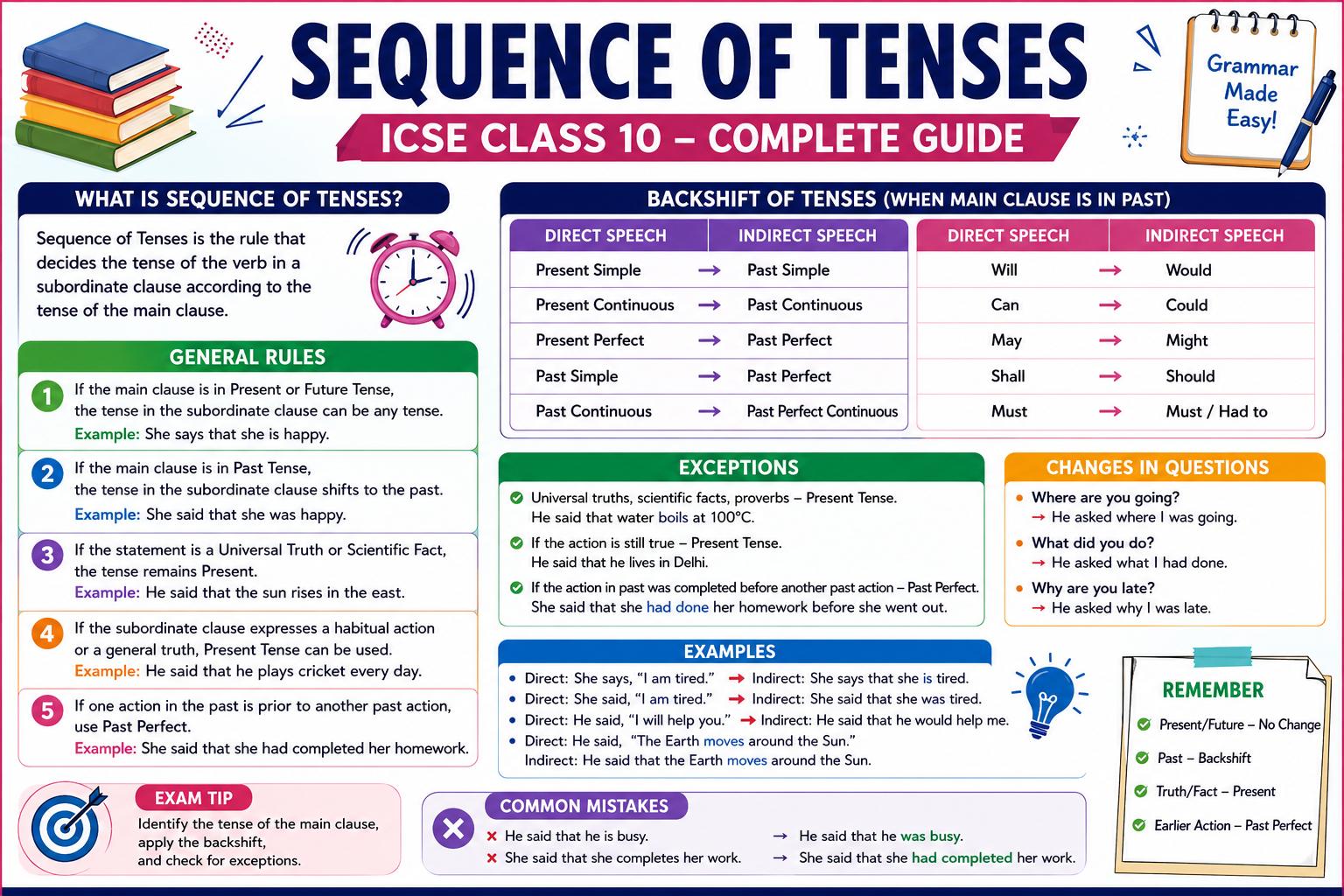
Main Rules of Sequence of Tenses
Rule 1: Main Clause in Present or Future Tense
If the verb in the main clause is in the Present or Future Tense, the subordinate clause can be in any tense according to the meaning.
Examples:
-
She says that she is happy.
-
She says that she was ill yesterday.
-
She says that she will come tomorrow.
-
He will tell us that he has completed the work.
Important Point
The tense of the subordinate clause depends on the sense or meaning of the sentence.
Rule 2: Main Clause in Past Tense
If the verb in the main clause is in the Past Tense, the subordinate clause generally changes into a corresponding past tense.
Examples:
-
He said that he was tired.
-
She told me that she had finished her homework.
-
They said that they would help us.
Backshift Rule Table
| Direct Speech | Indirect Speech |
|---|---|
| Present Simple | Past Simple |
| Present Continuous | Past Continuous |
| Present Perfect | Past Perfect |
| Present Perfect Continuous | Past Perfect Continuous |
| Past Simple | Past Perfect |
| Past Continuous | Past Perfect Continuous |
| Will | Would |
| Shall | Should |
| Can | Could |
| May | Might |
Detailed Explanation of Tense Changes
1. Present Simple → Past Simple
Direct:
He said, “I play cricket.”
Indirect:
He said that he played cricket.
2. Present Continuous → Past Continuous
Direct:
She said, “I am studying.”
Indirect:
She said that she was studying.
3. Present Perfect → Past Perfect
Direct:
He said, “I have completed my work.”
Indirect:
He said that he had completed his work.
4. Past Simple → Past Perfect
Direct:
She said, “I went to school.”
Indirect:
She said that she had gone to school.
5. Future Tense → Conditional Form
Direct:
He said, “I will help you.”
Indirect:
He said that he would help me.
Exceptions to the Sequence of Tenses
Exception 1: Universal Truths
If the subordinate clause expresses a universal truth, scientific fact, or permanent truth, the tense does not change.
Examples:
-
The teacher said that the Earth revolves around the Sun.
-
He said that honesty is the best policy.
-
The scientist explained that water boils at 100°C.
Important Note
Universal truths always remain in the Present Tense.
Exception 2: Habitual Actions or General Facts
If the statement expresses a habit or something still true at present, the present tense may be retained.
Examples:
-
He said that he plays football every evening.
-
She said that she lives in Lucknow.
Exception 3: Historical Facts
Historical facts may remain in the present tense if the fact is still accepted universally.
Example:
-
The teacher said that Akbar was a great emperor.
Sequence of Tenses in Questions
The same rules apply in interrogative sentences.
Example 1
Direct:
He said, “Where are you going?”
Indirect:
He asked where I was going.
Example 2
Direct:
She said, “What have you done?”
Indirect:
She asked what I had done.
Sequence of Tenses in Commands and Requests
Commands and requests usually use infinitives.
| Type | Structure |
|---|---|
| Command | told + object + to |
| Request | requested + object + to |
| Advice | advised + object + to |
Examples:
-
He said, “Open the door.”
-
He told me to open the door.
-
-
She said, “Please help me.”
-
She requested me to help her.
-
-
The teacher said, “Work hard.”
-
The teacher advised us to work hard.
-
Common Errors in Sequence of Tenses
Incorrect:
He said that he is tired.
Correct:
He said that he was tired.
Incorrect:
She said that she completes her work.
Correct:
She said that she had completed her work.
Incorrect:
He said that the sun rose in the east.
Correct:
He said that the sun rises in the east.
Tips to Solve Verb Filling Questions in ICSE
1. Identify Time Words
Words such as:
-
yesterday
-
last week
-
ago
-
tomorrow
help determine the tense.
2. Look for Earlier Actions
If one action happened before another action in the past, use Past Perfect.
Example:
-
When I reached the station, the train had left.
3. Identify Universal Truths
Universal truths remain in Present Tense.
Example:
-
The teacher said that the Earth moves around the Sun.
4. Observe Reporting Verbs
Words like:
-
said
-
told
-
asked
-
explained
usually indicate tense backshift.
ICSE Board Style Practice Questions
Exercise A – Change into Indirect Speech
-
He said, “I am tired.”
-
She said, “I have completed the project.”
-
He said, “I will visit Delhi.”
-
She said, “I can solve the question.”
-
The teacher said, “The Earth revolves around the Sun.”
-
He said, “I went to the market.”
-
She said, “Where are you going?”
-
He said, “Please help me.”
-
She said, “Do your homework.”
-
He said, “I was reading a novel.”
Exercise B – Fill in the Blanks
-
He said that he ______ tired. (be)
-
She said that she ______ the work. (complete)
-
He said that he ______ the next day. (come)
-
The teacher said that water ______ at 100°C. (boil)
-
She said that she ______ cricket every day. (play)
-
When I reached the station, the train already ______. (leave)
-
The boys ______ football when it started raining. (play)
-
He said that he ______ preparing for the examination. (be)
-
She told me that she ______ her homework. (finish)
-
The teacher advised us that we ______ regularly. (study)
Answers to Practice Questions
Exercise A Answers
-
He said that he was tired.
-
She said that she had completed the project.
-
He said that he would visit Delhi.
-
She said that she could solve the question.
-
The teacher said that the Earth revolves around the Sun.
-
He said that he had gone to the market.
-
She asked where I was going.
-
He requested me to help him.
-
She told me to do my homework.
-
He said that he was reading a novel.
Exercise B Answers
-
was
-
had completed
-
would come
-
boils
-
plays
-
had left
-
were playing
-
was
-
had finished
-
should study
Board Examination Strategy
To score well in Sequence of Tenses:
-
Learn tense conversion tables thoroughly.
-
Practice reported speech daily.
-
Revise universal truth exceptions.
-
Solve grammar passages regularly.
-
Focus on identifying time references.
-
Read the sentence carefully before choosing the tense.
Quick Revision Summary
Present Main Clause
-
Any tense possible.
Past Main Clause
-
Subordinate clause shifts back.
Universal Truth
-
Present tense remains unchanged.
Earlier Past Action
-
Use Past Perfect.
Conclusion
Sequence of Tenses is a scoring topic in ICSE English Grammar. Students who understand tense relationships and practice regularly can solve grammar questions quickly and accurately.
Consistent practice of reported speech, verb filling exercises, and grammar passages will improve confidence and help students perform well in examinations.
Need more ICSE materials?
Get our premium revision series for Class 10.