History and Civics
Browse All Notes
Judiciary
P
Aven
April 17, 2026 • Study Resource
Meaning of Judiciary
The Judiciary is the branch of government that interprets laws, settles disputes, and ensures justice in the country.
It safeguards the Constitution and protects Fundamental Rights.
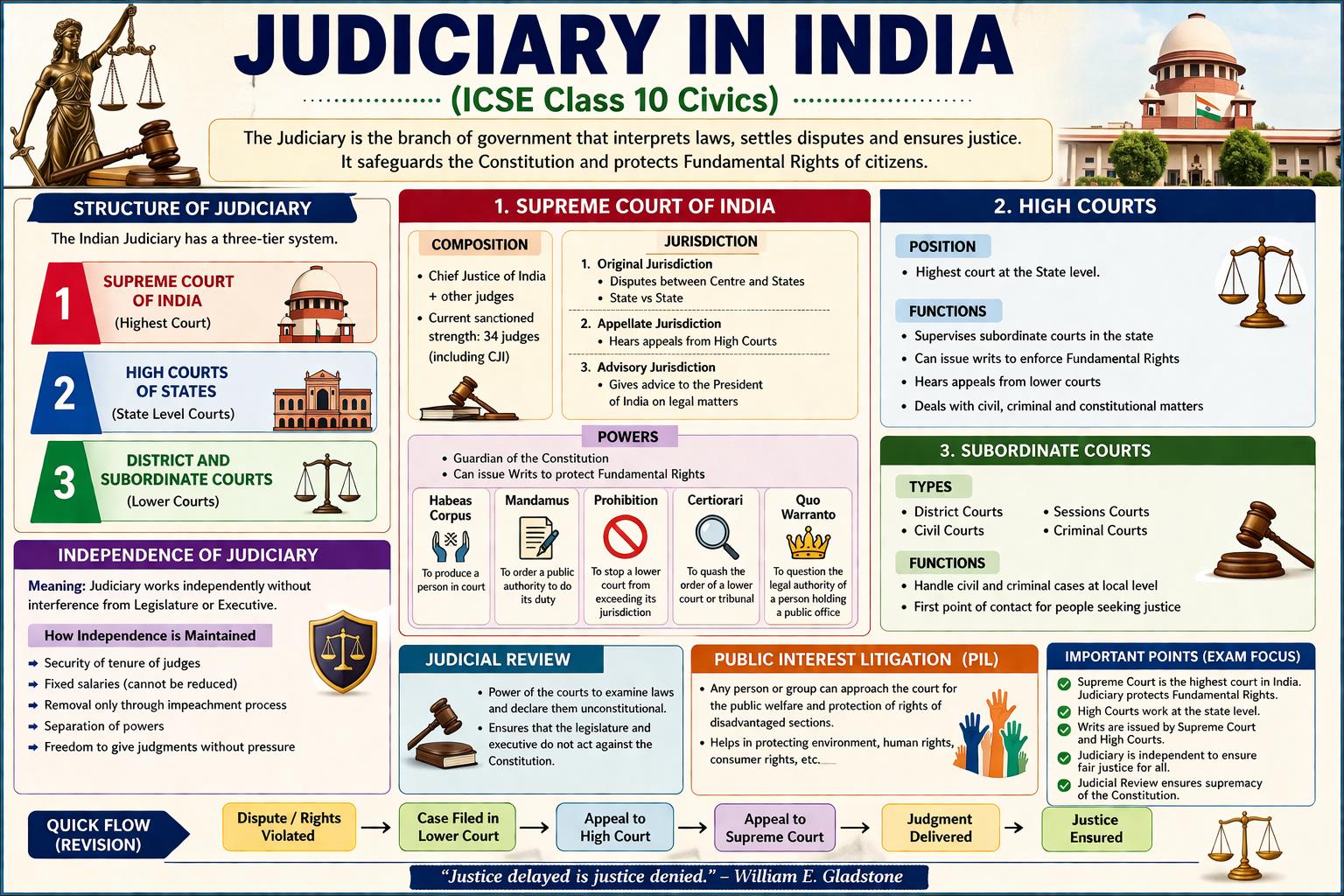
Structure of Judiciary in India
The Indian Judiciary has a three-tier system:
- Supreme Court of India (Highest Court)
- High Courts of India
- District and Subordinate Courts
1. Supreme Court (Apex Court)
Composition
- Chief Justice of India + other judges
- [Unverified] Current sanctioned strength: 34 judges
Jurisdiction
1. Original Jurisdiction
- Disputes between:
- Centre and States
- State vs State
2. Appellate Jurisdiction
- Hears appeals from High Courts
3. Advisory Jurisdiction
- Gives advice to the President of India
Powers
- Guardian of the Constitution
- Can issue Writs:
- Habeas Corpus
- Mandamus
- Prohibition
- Certiorari
- Quo Warranto
2. High Courts
Position
- Highest court at the State level
Functions
- Supervises subordinate courts
- Can issue writs
- Hears appeals from lower courts
3. Subordinate Courts
Types
- District Courts
- Sessions Courts
- Civil Courts
- Criminal Courts
Functions
- Handle civil and criminal cases at local level
Independence of Judiciary
Meaning
Judiciary works independently without interference from Legislature or Executive
How Independence is Maintained
- Security of tenure of judges
- Fixed salaries (cannot be reduced)
- Removal only through impeachment
- Separation of powers
Judicial Review
- Power of courts to declare laws unconstitutional
- Ensures supremacy of Constitution
Public Interest Litigation (PIL)
- Any person can approach court for public welfare issues
- Helps protect rights of weaker sections
Important Exam Points
- Supreme Court = Highest court of India
- Judiciary protects Fundamental Rights
- High Courts work at state level
- Writs are issued to enforce rights
- Judiciary is independent
Need more ICSE materials?
Get our premium revision series for Class 10.